Autism Cancer Birds Bees
Autism/Cancer/ Birds & Bees (Links)
What does autism, cell phone subscriptions, bird migration and insects have to do with each other? Maybe something or nothing.I found some interesting statistics between the number of autism cases per 1000 (ages 6-21 ) and the number of cell phone subscribers. From 1997 to 2002 the number of cell phone subscriptions tripled, from 55.3 million to 140.77 million. The number of autistic cases went from approx. 40/1000 to approx. 110 in 2002.
As for bird migrations, my theory is that the increase in varying species of birds becoming resident birds is due to the possibility that they have lost their ability to navigate. The decrease in insect population is also anecdotal. Possibly you might have noticed that the number of insects in our area has decreased along with the decrease in bird populations. Correlation? I don’t know. Speculation is open and rampant. I am proposing that many if not most life forms are susceptible to varying degrees to radiation emitted by cell phone towers and any other electrical or electronic device. Worth further discussion?
Birds Navigate Using Magnetic Compass-Vision
http://discovermagazine.com/2007/oct/birds-navigate-using-magnetic-compass-vision#.UogS2OL3PoA
Combined with a GPS beak, it leads them on marathon migrations.
| By Andrea Anderson | Tuesday, October 30, 2007 |
RELATED TAGS: SENSES, ANIMAL INTELLIGENCE, EARTH SCIENCE, UNUSUAL ORGANISMS


Dominik Heyers’ imagining of what avian magneto-vision might look like.
Garden warbler image courtesy of Henrik Mouritsen
For decades, scientists have known that migratory birds use Earth’s geomagnetic field—along with light, stars, and other cues—to guide them on remarkably long journeys. But it is unclear just how birds sense this relatively weak field and use it for navigation.
Now German researchers have provided new evidence supporting the notion that migratory birds actually see magnetic fields. Postdoctoral fellow Dominik Heyers and his colleagues peered into the brains of garden warblers, which travel seasonally between northern Europe and southern Africa, and uncovered a link between neurons in the eye and a region of the brain thought to be involved in migration.
To see how the warblers perceived magnetic fields, the team first had to “get the birds in a migratory mood,” which they did by shortening the birds’ exposure to light, Heyers says. Then they injected a dye into cluster N, a region of the brain that is likely related to migration because it is highly active at night and when birds are keen to migrate, says group leader Henrik Mouritsen. Then the researchers injected a second dye into the birds’ eyes. Sure enough, the two dyes oozed along different sets of neurons and met in the thalamus, a relay station for visual information deep in the brain.
The data supports a theory, first proposed in the late 1970s, that has been bolstered by increasing evidence over the past 10 to 15 years—that birds collect magnetic-field information through specialized receptors in the eye. Researchers don’t know for sure what this receptor would be, but cryptochrome—a protein known to be involved in some animals’ circadian rhythms—has been found in the eyes of several migratory birds and is a prime candidate.
Several years ago, biophysicists predicted the properties that a magnetic field–sensing molecule should have, and cryptochrome fit the bill. Unlike typical bird photoreceptor proteins that change shape when they absorb light energy, cryptochrome generates free electrons when it absorbs light. Earth’s magnetic field may influence the spin of these free electrons, which birds could then detect, explains biophysicist Thorsten Ritz of the University of California at Irvine, who was not involved in the Heyers study. If so, then north and south look inherently different to migratory birds, and even when flying over open ocean on a starless night, they may use that distinction to stay on course.
Researchers have long known that migratory birds receive information about magnetic fields from a part of their upper beak called the magnetite receptor, which contains iron-based magnetic crystals. This receptor seems to measure the strength of the magnetic field—the field is generally strongest at the poles—and the angle of the field in relation to the ground, which also varies with latitude.
Heyers suggests that the magnetite receptor and the visual magnetic receptor complement one another, with birds using the receptors in their beaks like GPS and using visual magnetic information like a compass to determine which way they’re facing. “If you have a direction but don’t know where you are, that probably won’t help you find your way,” Heyers explains.
The Dark Spot Called “North”?
So if birds actually do see the geomagnetic field, what does it look like? “We don’t know exactly how it looks at all,” Mouritsen says. Based on the theory that magnetic fields affect the overall light sensitivity of birds’ eyes, Heyers’s best guess is that birds see north as a dark spot, with a gradient of light representing other directions.
Still, there are many remaining questions. While Ritz calls the new study “interesting” and “really necessary,” he also emphasizes that the new data correlate vision with magnetic-field sensing rather than absolutely defining the neural pathway. Rachel Muheim, a postdoctoral fellow at Virginia Tech, agrees, saying there are still questions about whether the vision-related cluster N is involved in detecting magnetic fields or just in night vision.
“Definitive proof is still lacking,” Mouritsen admits. Still, he argues, differences in cluster N activity between migratory and nonmigratory birds indicate it does have a role in navigation, and the new data fit predictions of the visual magnetic perception theory. “We have a lot of correlative evidence that is very hard to explain if this is not true.”
###
http://www.infoplease.com/ipa/A0933563.html
Cell Phone Subscribers in the U.S., 1985–2010
Year
Subscribers
1985
340,213
1986
681,825
1987
1,230,855
1988
2,069,441
1989
3,508,944
1990
5,283,055
1991
7,557,148
1992
11,032,753
1993
16,009,461
1994
24,134,421
1995
33,758,661
1996
44,042,992
1997
55,312,293
1998
69,209,321
1999
86,047,003
2000
109,478,031
2001
128,374,512
2002
140,766,842
2003
158,721,981
2004
182,140,362
2005
207,896,198
2006
233,000,000
2008
262,700,000
2009
276,610,580
2010
300,520,098
| Read more: [Cell Phone Subscribers in the U.S., 1985–2010 | Infoplease.com](http://www.infoplease.com/ipa/A0933563.html#ixzz2kaLEvhvK) http://www.infoplease.com/ipa/A0933563.html#ixzz2kaLEvhvK |
http://blog.chron.com/sciguy/2012/03/as-cell-phone-use-has-risen-in-the-u-s-has-brain-cancer-also-increased/
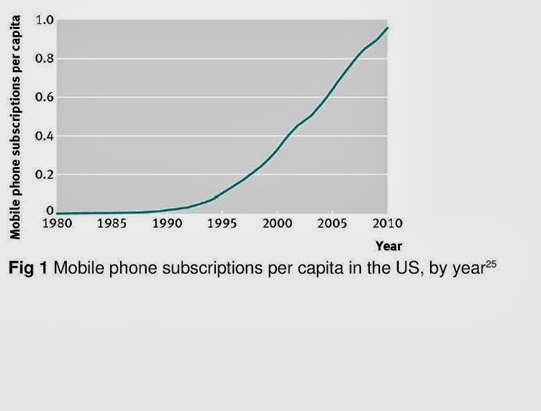
Autism & Cell Towers: Electromagnetic Radiation Connection Possibility
http://www.dailykos.com/story/2012/04/11/1082549/-Autism-Cell-Towers-Electromagnetic-Radiation-Connection-Possibility#
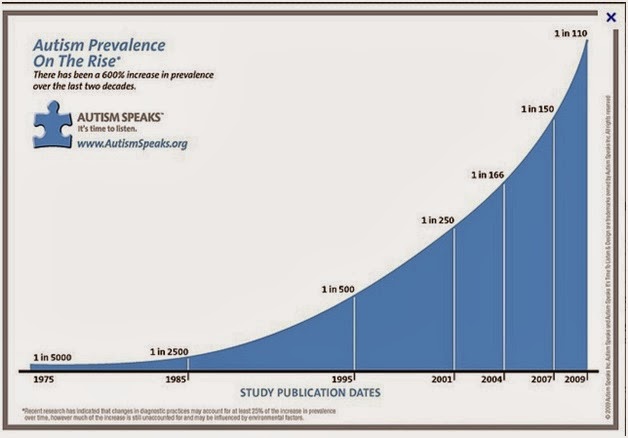
I think that the susceptibility of people to radiation and its effects depend on the radiation density, the age of people exposed, including prenatal, duration of exposure and length of time both short time and long term.
Yes, statistics and graphs can be viewed in many ways.
http://www.abc.net.au/science/k2/trek/4wd/Over57.htm
Magnetic Bees
Each honeybee hive produces about 29 kg of honey per year. To help them make this honey, the bees talk to each other - and just recently, some scientists have learnt to speak this language!
The story begins back in 1923, when Karl von Frisch from the University of Munich in Germany, published his first paper on the language of the honeybees. He reckoned that they ‘‘spoke’’ with each other by dancing the dance!
Suppose a honeybee has found a flower bed rich in nectar and pollen. She flies back, into the hive, and tells her fellow workers about the flowers - by dancing.
If the flowers are within 100 metres of the hive, she flies in circles. Soon, her fellow workers leave the hive, and fly in ever-enlarging circles until they find the flowers.
But if the flowers are further away (up to 3 kilometres away), she dances a different dance inside the nest. She flies in a straight line, while waggling her rear end, and then flies a curved line to the beginning of the straight line, and does it all again. If her straight line points vertically up, then the other bees leave the nest, and fly in the direction of the Sun. And if the straight line points 60o to the right of vertical, the other bees fly in a direction 60o to the right of the Sun. And the speed of her waggling bottom tells the other bees the distance to the flowers - the faster the waggle, the closer the food!
Karl von Frisch received a Nobel Prize for this theory in 1973. But his theory didn’t go far enough. Most beehives are pretty dark inside, and like us, honeybees can’t see very well in the dark. So how can they see each other do the dance?
In the 60s, other scientists discovered that dancing honeybees emitted a sound from their wings, vibrating at 220 beats per second. They were singing a song with their wings. And honeybees do have a sort-of-ear on the second joint of their antennae. It seemed reasonable that bees could hear this song, but how do you prove it?
In the late 80s, Wolfgang H. Kirchner and William F. Towne proved it with a robot honeybee. It had razor blades for wings, and tiny computer-controlled motors to make it dance. It could sing the song with its razor blade wings, and dance the dance via its electric motors.
A real honeybees would ignore their robot razor blade honeybee, if it just danced the dance, or just sang the song. But when it did both the song and the dance, the real honeybee would obey it. The scientists could actually talk to the animals! They could get their robot honeybee to send the real honeybees out of the nest in any direction they wanted!
So by using a song-and-dance routine, the bees can tell each other the best place to eat out.
But once they’ve picked up their nectar and pollen, how do they find their way back to the hive? Honeybees have another trick - tiny compasses, in their tummies, that sense the Earth’s magnetic field.
Now under the right conditions, magnetic fields can effect humans. Susan Blackmore wrote about her experiences in the New Scientist, after a neuroscientist had blasted her brain with intense magnetic fields in his laboratory.
She felt nothing for the first ten minutes. Then, even though she knew that she was reclining perfectly still in a chair, she felt as though she was swaying on a hammock. Almost immediately afterwards, even though she knew that there was nobody near her, she could feel “two hands grabbing her shoulders and pulling her upwards.” As the magnetic fields continued to act on her brain, she could ‘‘feel’’ something grab one of her legs and try to pull it up the wall - although her eyes told her nothing was happening!
And then the magnetic fields began to act on her emotions. She suddenly felt very angry - but she didn’t know what she was angry about, nor at whom she was angry. This anger lasted only 10 seconds, but as it faded, she was suddenly beset with a very intense attack of fear. Again, she was not scared of anyone or anything, but she was very afraid.
Now the human brain is very complicated, and we don’t know why intense magnetic fields can cause such dramatic changes. But we do have a better idea of what’s going on in honeybees.
There are a few different types of magnetic materials. One is a type of iron oxide called magnetite, which is naturally magnetic, and we know that lots of creatures have tiny magnets of magnetite in their bodies.
But there’s another type of iron oxide which is paramagnetic. Paramagnetic materials are themselves not magnetic, but, they are pulled by magnetic fields. So a non-magnetic paper clip made of soft iron is actually paramagnetic, because it can be pulled by a magnet.
According to doctors Hsu and Li of the National Tsing Hua University in Taiwan, honeybees have tiny paramagnetic particles in their bodies. These paramagnetic particles are inside cells inside the bees’ tummy. Depending on whether they are lined up side-by-side, or end-to-end, these paramagnetic particles can, as the external magnetic field changes, swell or shrink. But, these paramagnetic particles are attached to the ‘‘walls’’ of the cells that they are in, so as the paramagnetic particles change shape, so do the cell walls. And nerves, attached to the outside of these cells, carry signals up to the honeybee’s brain.
So the magnetic cells in the bees tummy are like tiny onboard compasses. This is the first time scientists have actually followed the ‘‘line of information’’ in a living animal, from the magnets to its brain.
Now honeybees are told how to leave the nest and where to go by the buzzing wings and waggling dance of another honeybee. And, by using the paramagnetic particles of iron oxide, these honey bees can avoid getting lost on the way home, and iron out their problems with a little magnetic navigation.
Copyright © Karl S. Kruszelnicki

Honey Bee Colony Collapse Disorder, In Context
http://www.myrmecos.net/2011/03/10/honey-bee-colony-collapse-disorder-in-context/
Honey Bee Colony Collapse Disorder, In Context
l
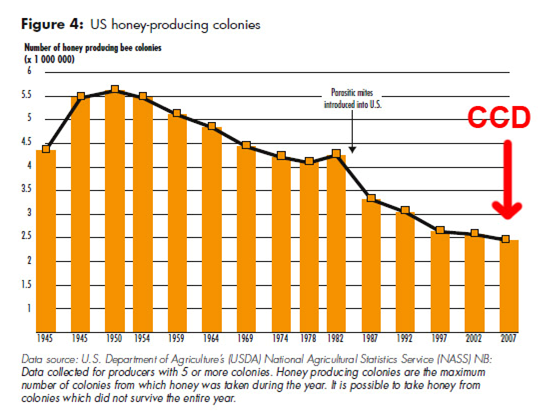
Is it possible that the failure of bees to return to their colony is not only effected by pesticides and mites but increased radiation density (primarily from cell phone towers) as well?
March 10, 2011 by alexwild
The U.N. has released a brief report (pdf) on the global state of pollinators. As with most such reports, it only contains substantive information about one species, the western honey bee, as data do not exist for the vast majority of other pollinators.
The report contained this figure, which I have modified to indicate the arrival of Colony Collapse Disorder:
For all the hoopla over CCD, the reality is that non-African Apis mellifera on the North American continent has been declining for decades, and that CCD, whatever it may be, is just the latest in a string of challenges. Data are sketchy for other pollinators, but there are reasons to believe the decline is more general.
If I may be permitted to speculate, I suspect the gradual decline reflects gradual changes in landscape use and commerce since the 1950s. The rise of large-scale agriculture and urban sprawl, together with a decrease in the small farms inclined to beekeeping, has decimated the diversified landscape that supported earlier populations. Concurrently, globalization brought new bee pests to our shores- look at the effect of Asian Varroa mites in the 1980s!- and has increased the traffic of pests around the continent.
If we wish to return the domestic honey bee to its historically large population sizes, we’d do well to focus on larger landscape management issues rather than zeroing in on particular diseases or afflictions. Otherwise, we risk not seeing the forest for the bees.
Disclaimer: The interpretation of facts and figures like beauty are often left to the imagination and eye of the beholder. This is mainly brainstorming about topics of the day. The object of brainstorming is to come up with new ideas and approaches pertaining literally to anything i e new products, old products, philosophy, science, engineering, medicine, art, etc. and anything else. I am not necessarily approaching these topics in a clearly scientific approach but more in an anecdotal method. (if that is a method)